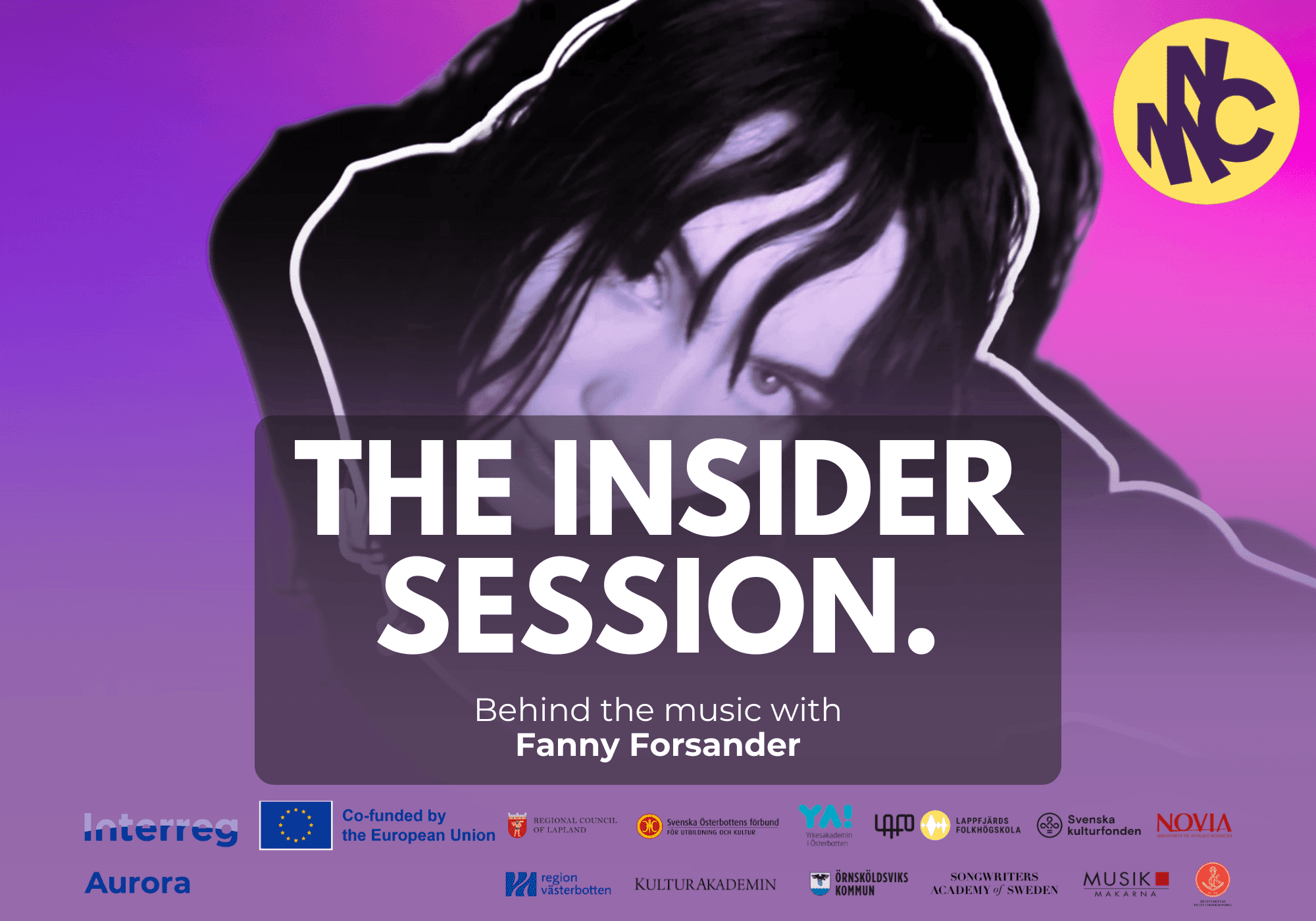
When you meet Fanny Forsander, originally from Jakobstad but nowadays based in Stockholm, you quickly understand that she’s someone who refuses to fit into a single box. Producer, songwriter, radio host, artist – her career is a collage of creative paths that somehow successfully forms a cohesive whole. For emerging music creators, her journey is a reminder that there is no single “right” way to build a life in music.
“I’ve always done a lot of different creative things”
Fanny’s relationship with music began early, but it wasn’t until her mid-teens that she realised it was more than a hobby.
“I’ve always done a lot of different creative things, but I think I was around 16–17 when I decided that music is what I want to do,” she says. She started writing songs, joined a choir, and slowly began exploring different creative roles.
Her path since then has been anything but linear. She studied at Novia University of Applied Sciences in Jakobstad, attended RockMusikLinjen in Stockholm, worked at Yle in Helsinki, and later graduated from Musikmakarna in Örnsköldsvik.
“Education isn’t necessary to become a producer or songwriter, but for me it was everything. Every program gave me something important – not just technically, but creatively. And it’s where I met 90% of my network.”
For Fanny, her education also offered valuable time – time to grow, experiment, fail, and refine her craft without the pressure of immediate commercial success.
Finding her place in Sweden’s music industry
During her time at Musikmakarna, Fanny set her sights on the Swedish music industry.
“I had this idea that I wanted to sign somewhere. Not because you have to, but because I felt it would help me reach the next level.”
In her second year, she signed with a publisher as both producer and songwriter – a milestone she describes as a dream come true. But signing also came with new realities.
“Working commercially means you get an advance – and you have to pay it back by making music that performs. It’s easy to lose yourself in that. It’s hard not to compromise your taste when your music also has to generate money.”
Her next dream is, therefore, finding the balance between the music that pays the bills and the music that feels like her.
“Music is generating more money than ever, but it’s never been this tough for producers, songwriters, and artists. The distribution is completely skewed.”
Still, she’s surprisingly optimistic about AI.
“Maybe AI can take over the boring stuff – the 60-year-birthday songs and the elevator music. Then I can focus on the music that has artistic value.”
Her hope is that the industry will eventually rebuild itself, and that she’ll get to be part of that shift.
Staying grounded
When asked what she wishes she’d known earlier, Fanny doesn’t hesitate.
“The best advice I ever got was: remember that they work for you. As a Nordic person with ‘jantelagen’ (eng: Law of Jante) in your bones, you walk into meetings wanting to please everyone. But if you’re not happy, it’s worthless.”
Fanny also challenges the idea that the ultimate goal is to live entirely off your music.
“If you don’t have a trust fund, you’ll need to accept a lot of bullshit jobs,” she says.
She’s seen too many people lose their love for music in the grind. For her, working part-time and making music the rest can be a healthier, more creatively free path.
Her approach to the industry is deeply tied to her personal qualities – ambition, honesty, and a strong sense of self. Fanny describes herself as extroverted and social, something that has helped her in networking-heavy environments. But she’s quick to point out that introverts succeed too.
“People like ambitious people. If you’re driven, it doesn’t matter if you’re introverted or extroverted.”
Her story is a reminder that a music career doesn’t have to be linear, perfect, or predictable. It just has to be yours.
BONUS: How to reach out to people in the industry – Fanny’s practical tips
Fanny often receives messages from emerging creators, and she’s happy to help, but she’s noticed a pattern in what works and what doesn’t. Her advice may sound simple, but they can be the difference between being ignored and moving forward.
Here are her essentials:
- Be clear about what you want. Don’t just ask for “tips on labels.” Explain your genre, your goals, and why you’re asking.
- Do your research. If you ask for a specific person at a specific company, it shows you’ve done the work.
- Keep your email short. No life story, no childhood anecdotes. A short intro + links is enough.
- Make sure your links work. No Dropbox permissions, no broken Google Drive links.
- Follow up. People are busy, so a gentle nudge after a week is completely fine.
Read more news